
Resetting the World Order: From the Industrial World to the Digital World And What Does This Mean for Tanzania?
In my reflections on the global order, I often find myself returning to a period when the world appeared to undergo a fundamental shift; a period that gave birth to an era which I now believe is approaching its conclusion. As that era reaches its natural limits, the system itself appears to be resetting.
My thoughts often go back to the 1970s and 1980s, when the Middle East emerged as one of the most consequential regions on earth because of its role in oil production and supply. Oil is energy, and in an industrial world, energy is both literally and figuratively power. At the time, the United States stood as the world’s dominant industrial force. Consequently, securing access to the energy required to sustain that industrial capacity became a matter not merely of economics, but of national security and geopolitical influence.
It was during this period that many of the foundations of the modern global order were cemented. The control of energy supply, its transportation, and its pricing became inseparable from questions of power, sovereignty, and influence. Arguably, petroleum remains one of the most important strategic resources in the world today because virtually every modern economy still depends upon it, directly or indirectly.
Yet when we look at the present moment, a moment many describe as chaotic, disruptive, or even disorderly, I am not convinced that we are witnessing anything fundamentally new. Rather, we are witnessing a familiar contest expressed through new actors, technologies, and circumstances.
History has always been shaped by competition over limited but critical resources. The resources themselves may change, but the struggle rarely does. Civilizations compete for those assets that determine their prosperity, security, and ability to project power. Sometimes the contest is military, sometimes economic, sometimes technological, but at its core it remains a contest over the foundations of influence and survival.
What has changed is not the nature of the competition but the resources at stake.
The industrial world was powered by oil. The digital world is powered by energy as well, but energy of a different character and delivered through a different ecosystem. Data centers, artificial intelligence, semiconductor fabrication, cloud computing, telecommunications networks, robotics, and the infrastructure of the digital economy all require enormous amounts of energy to function. If anything, humanity’s dependence on energy has increased, not diminished.
The difference is that in the industrial age, strategic control centered primarily on oil fields, shipping lanes, pipelines, and refineries. In the digital age, strategic control extends beyond traditional energy sources to include critical minerals, rare earth elements, advanced semiconductors, data infrastructure, artificial intelligence, and the technologies that convert energy into digital power.
Viewed through this lens, the actions of major global powers are neither surprising nor unprecedented. Just as nations sought to secure access to and influence over the energy systems that defined the industrial age, they now seek to maintain influence over the resources, technologies, and supply chains that will define the digital age. The objective remains largely unchanged: to preserve sovereignty, sustain economic strength, and shape the balance of power in an increasingly competitive world.
This is why I believe much of what appears to be chaos today is, in reality, a reflection of a system in transition. The world is moving from one dominant model of production, power, and influence to another. Such transitions have never been orderly. They have always produced uncertainty, friction, and competition as established powers seek to adapt and emerging powers seek to redefine the rules.
The global order is not collapsing. It is resetting.
What we are witnessing is not the end of competition, but the transfer of strategic importance from the resources that powered the industrial world to those that will power the digital world. The contest remains the same. The battlefield has changed. The stakes have not.
For Tanzania, this global transition presents a historic opportunity.
The late President John Pombe Magufuli’s audacious drive to invest in strategic infrastructure and strengthen the country’s control over its natural resources fundamentally altered Tanzania’s trajectory. Whether it was railways, ports, power generation, roads, bridges, or reforms within the mining sector, the underlying objective was clear: Tanzania needed to build the foundations upon which future prosperity could stand.
Infrastructure was never the destination. It was the platform.
President Samia Suluhu Hassan’s administration has, in many respects, elevated this trajectory by moving beyond the language of projects and towards the language of ecosystems. The conversation is no longer simply about building a port, a railway, an airport, or a power plant. The conversation is increasingly about what economic ecosystem those assets enable, what industries they attract, what value chains they support, and how they can be integrated into regional and global markets.
This distinction is important.
The industrial world rewarded those who possessed resources. The emerging digital world will reward those who can organize resources, infrastructure, technology, skills, and capital into functioning ecosystems capable of generating sustained value.
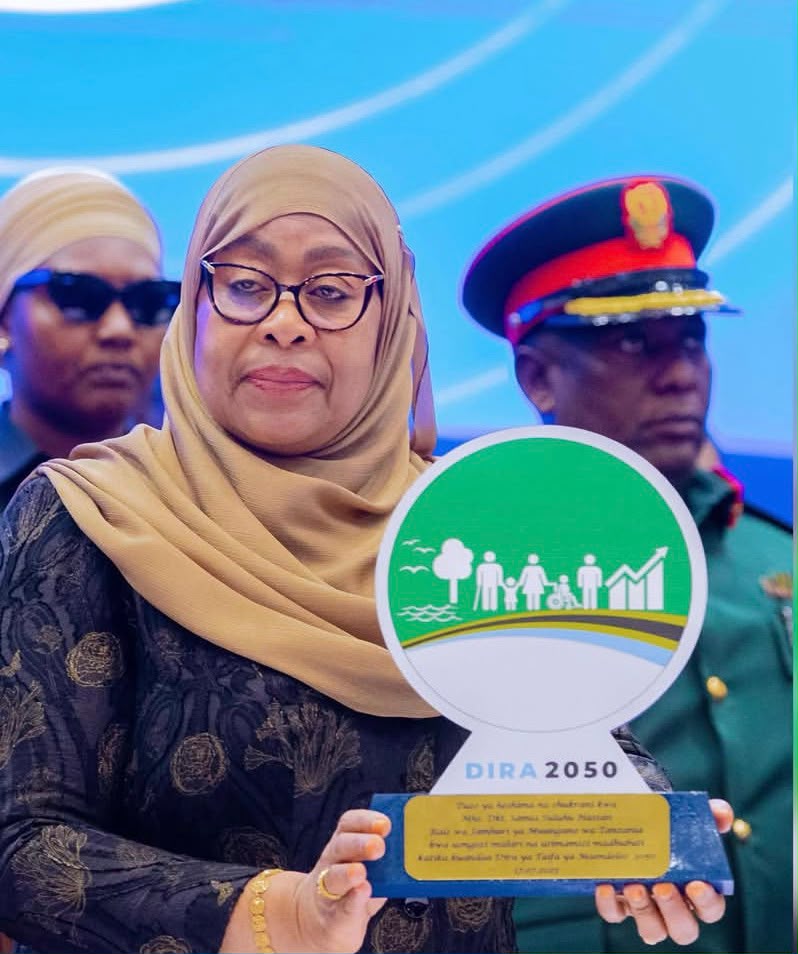
Viewed through this lens, DIRA 2050 arrives at precisely the right moment.
The world is searching for reliable partners, stable supply chains, critical minerals, energy security, food security, strategic locations, and new frontiers for growth. Tanzania possesses many of these attributes. More importantly, for perhaps the first time in our modern history, we possess the infrastructure, the institutional experience, and the strategic vision necessary to leverage them effectively.
This places Tanzania in a position of leverage rather than compromise.
Historically, developing nations often approached the global order from a position of need. They sought investment because they lacked the foundations necessary to negotiate from a position of strength. Today, Tanzania finds itself in a different position. The infrastructure foundations have largely been laid. The next phase is to build ecosystems around them and align those ecosystems with the realities of the emerging global order.
This is where the continuity between the Magufuli and Samia administrations becomes most evident. One focused on building the foundations. The other is increasingly focused on maximizing the value that those foundations can generate. One laid the tracks. The other is building the networks that will run upon them.
Together, they have positioned Tanzania to participate in the emerging world order from a position of greater confidence and strategic relevance than at any point in recent memory.
This is why DIRA 2050 should not be viewed merely as an economic blueprint. It should be understood as a national organizing framework. A framework that aligns infrastructure, industry, education, technology, governance, and culture towards a common destination.
More importantly, DIRA 2050 must evolve beyond a government document and become a national movement.
A vision cannot succeed if it is owned only by policymakers. It must be understood by wananchi, debated by wananchi, challenged by wananchi, refined by wananchi, and ultimately embraced by wananchi. The true strength of any national vision lies not in the quality of the document itself but in the number of people who see themselves within it.
If the world order is indeed resetting, then Tanzania’s challenge is not simply to observe the transition. Our challenge is to position ourselves within it.
History rarely announces moments of opportunity. It often disguises them as periods of uncertainty and change.
The transition from the industrial world to the digital world may prove to be one of those moments.
For Tanzania, the question is no longer whether the world is changing.
The question is whether we can organize ourselves quickly enough, intelligently enough, and collectively enough to take advantage of that change.
We possess the resources.
We possess the geography.
We possess the infrastructure.
We possess the opportunity.
What remains is the discipline, vision, and collective will to transform those advantages into a national renaissance.
DIRA 2050 provides the framework.
The rest is up to us.
By Costantine V. Magavilla


